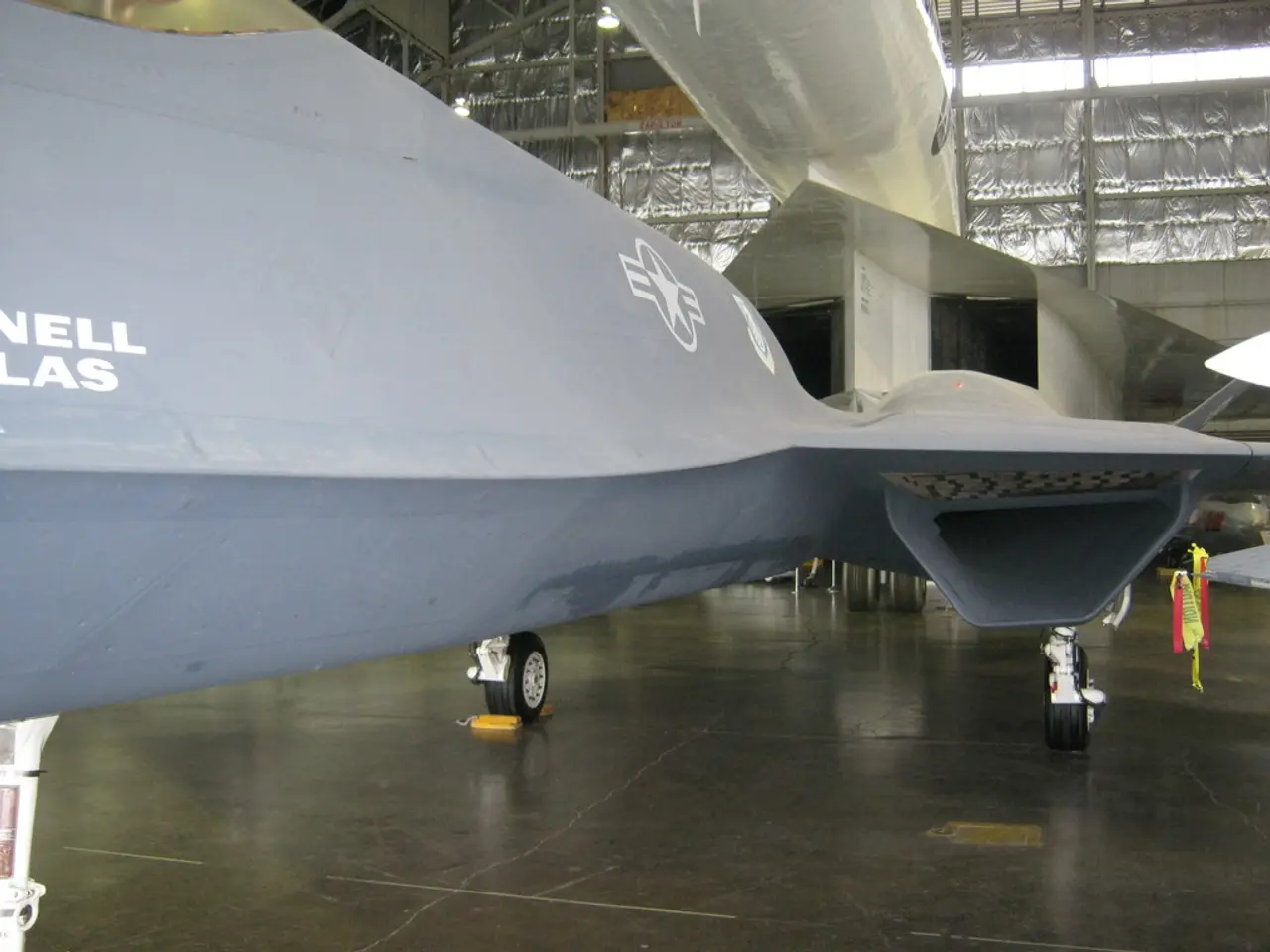
Air Force readies T-7 jets, set to commence flight tests within upcoming weeks
**News Article: T-7A Red Hawk Trainer Jet Program Progresses Despite Challenges**
The T-7A Red Hawk, a next-generation jet trainer designed to replace the aging T-38C Talon fleet, is making significant strides in its development under the U.S. Air Force's Advanced Pilot Training System (APTS) program.
Recent milestones in the T-7A program include the aircraft's successful completion of a second round of extreme environmental testing at the McKinley Climatic Laboratory at Eglin Air Force Base. This testing aimed to validate the aircraft's readiness under diverse environmental conditions.
The T-7A Red Hawk is expected to achieve initial operational capability (IOC) in early 2027, although specific dates have not been detailed in recent reports. The aircraft is designed to accelerate pilot readiness for fifth-generation fighters like the F-35 and F-22.
However, the relationship between the Air Force and Boeing, the primary contractor for the T-7A program, has faced some challenges. The Government Accountability Office previously described their relationship as "tenuous." Despite this, both parties have been working closely to ensure flight testing can start as soon as the first jet (ATP-2) is officially transferred to the Air Force.
The first production-representative T-7 started undergoing taxi tests and took its first official flight with an Air Force pilot in May and June. Following the transfer of ATP-2, ATP-1 is expected to be moved to Edwards Air Force Base for continued flight testing.
The T-7 program has faced skepticism from lawmakers due to the delays and issues encountered. One of the main concerns is the overlap of development, testing, and production phases, which has led to disagreements between the USAF and Boeing over interpreting test data related to the T-7's issues.
Air Force Secretary Frank Kendall has expressed caution about digital engineering, suggesting it may not significantly reduce development time and cost. The T-7 has faced issues with aircraft wing rock, flight control software, and the ejection seat system, which accommodates a wider range of body sizes.
Despite these challenges, the Air Force and Boeing have completed appropriate test readiness reviews and test planning requirements for flight testing. The outcome of whether a provision in the House version of the National Defense Authorization bill, which requires the Air Force to assess the risks associated with the T-7 program's overlapping phases, will survive the House-Senate conference to reconcile the House and Senate versions of the bill is yet to be determined.
The Air Force hopes to take ownership of a second aircraft (T-1 or ATP-1) shortly after ATP-2 is accepted. The two airframes (ATP-2 and T-1) will be used to test different factors: flight sciences for ATP-2 and loads for T-1.
Col. Kirt Cassell, T-7 division chief, mentioned that there have been leadership changes and a reorganization within Boeing, leading to a fresh set of eyes and a renewed relationship. This change has been instrumental in resolving some of the issues faced by the program.
In conclusion, the T-7A Red Hawk program is making progress, with significant testing completed to ensure the aircraft's readiness in diverse environments. While there are ongoing challenges with other Boeing contracts, the T-7A remains a priority for modernizing the U.S. Air Force's training capabilities. However, specific timelines for IOC and the exact nature of the Air Force-Boeing relationship in the context of recent issues remain to be clarified.
- The T-7A Red Hawk, designed to modernize the U.S. Air Force's training capabilities, is a key project within the aerospace industry, with Boeing serving as the primary contractor.
- The T-7A program's relationship with Boeing has faced challenges, as described by the Government Accountability Office, but both parties are working together to resolve these issues and commence flight testing.
- The T-7A Red Hawk is expected to be ready for initial operational capability (IOC) in early 2027, and its ability to accelerate pilot readiness for fifth-generation fighters like the F-35 and F-22 is a critical aspect of defense and space in the modern age.
- The T-7 program's progress and challenges have sparked debates in the realm of finance and law, with concerns over delays, digital engineering, and overlapping development, testing, and production phases. The outcome of these discussions is yet to be determined, potentially impacting the program's timeline and the nature of the Air Force-Boeing relationship.