Bundestag rejects AfD bid to defund investigative outlet CORRECTIV
German Parliament Rejects AfD Bid to Defund CORRECTIV After Contentious Debate
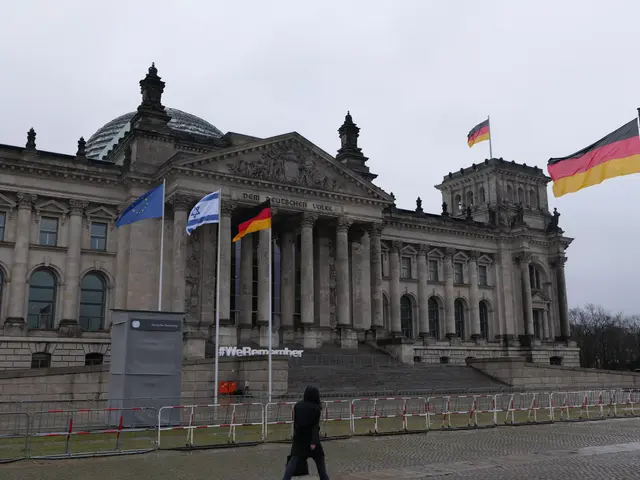
The Bundestag engaged in a heated debate on Thursday evening over reporting by the investigative outlet CORRECTIV. The far-right Alternative for Germany (AfD) had tabled a motion to strip the organization of public funding, which was overwhelmingly rejected by all other parliamentary groups.
The dispute stems from an April 2026 ruling by the Berlin Regional Court's press chamber, which took issue with certain phrasing in CORRECTIV's January 2024 investigation "Secret Plan Against Germany." The ruling is not yet final, as CORRECTIV has filed an appeal. Nevertheless, the AfD's motion called on the federal government to immediately halt all funding to the outlet.
The proposal faced broad opposition in parliament. Many speakers questioned whether the Bundestag was the appropriate forum for such a debate. Ottilie Klein (CDU), media policy spokesperson for the center-right Union faction, urged restraint, arguing that the courts should first deliver a final verdict. "This is a legal question, not a political one," she said. The Union also clarified that CORRECTIV had never received federal funding for its journalistic work—only for clearly defined educational projects.
CORRECTIV's investigative reporting is not publicly funded but relies on donations. Government grants are limited solely to distinct educational initiatives.
Holger Mann, deputy media policy spokesperson for the center-left Social Democrats (SPD), accused the AfD of seeking to "exploit a non-final ruling as political absolution." He pointed out that the party had omitted a key detail: In December 2025, the Hamburg Regional Court had reached the opposite conclusion, ruling that CORRECTIV's reporting was "unrestricted and permissible." "They just keep suing until they get the verdicts they want," Mann said.
His SPD colleague Martin Rabanus, the faction's media policy spokesperson, also defended the investigation, stating that CORRECTIV "did not fabricate anything but, in my view, conducted thorough and meticulous research." Addressing the AfD directly, he declared: "You are not the victims here—you are the perpetrators." He accused the party of promoting "ethnonationalist ideology" and secretly negotiating "remigration schemes" with far-right figures "behind closed doors."
Awet Tesfaiesus, a Green Party lawmaker and deputy chair of the Culture and Media Committee, emphasized that participants at the meeting in question "knew full well what—and whom—they were dealing with." She noted that far-right activist Martin Sellner had been so central to the event that his attendance was announced in the invitation. The AfD, she argued, was attempting to "silence journalism that inconveniences them."
Clara Bünger, the Left Party's domestic policy spokesperson, condemned the motion as "an attack on independent media" and accused the AfD of systematically "flooding newsrooms with lawsuits to bankrupt them." She framed the move as part of a broader strategy: the AfD was working to "discredit journalists in order to close ranks with the far right—and with the Union."
Pascal Reddig (CDU), a senior member of the Culture and Media Committee, sought to distance his party from the AfD in his remarks. While the Union advocates for "managed and orderly migration," he said, the AfD's goal is to ensure "no people of other skin colors remain in this country." At the same time, he criticized CORRECTIV, claiming its reporting had "crossed the line of journalism." As evidence, he cited public readings and theatrical performances based on the investigation, which he dismissed as "staged propaganda."
Reddig acknowledged, however, that while the Berlin court had challenged a specific factual claim, this did not invalidate the core allegations—including discussions about tightening legal frameworks to pressure people into "voluntarily leaving" the country.
For its part, the AfD used the debate to discredit CORRECTIV. Götz Frömming, the party's cultural policy spokesperson, branded the outlet a "denunciation platform" and called the investigation "a journalistic fiasco."
The substance of CORRECTIV's 2024 exposé—which revealed a networking meeting between AfD representatives, wealthy business figures, and far-right activists—remains uncontested. At its center was Martin Sellner's "remigration" concept.
In December 2025, the Hamburg Regional Court ruled that, "given the detailed account of the conversation, including numerous direct quotations and the use of indirect speech," readers could recognize "that other passages in the article represent evaluative summaries or commentary on the events." The Berlin Regional Court, however, deemed two of these passages impermissible.
Read also:
- American teenagers taking up farming roles previously filled by immigrants, a concept revisited from 1965's labor market shift.
- Weekly affairs in the German Federal Parliament (Bundestag)
- Landslide claims seven lives, injures six individuals while they work to restore a water channel in the northern region of Pakistan
- Escalating conflict in Sudan has prompted the United Nations to announce a critical gender crisis, highlighting the disproportionate impact of the ongoing violence on women and girls.