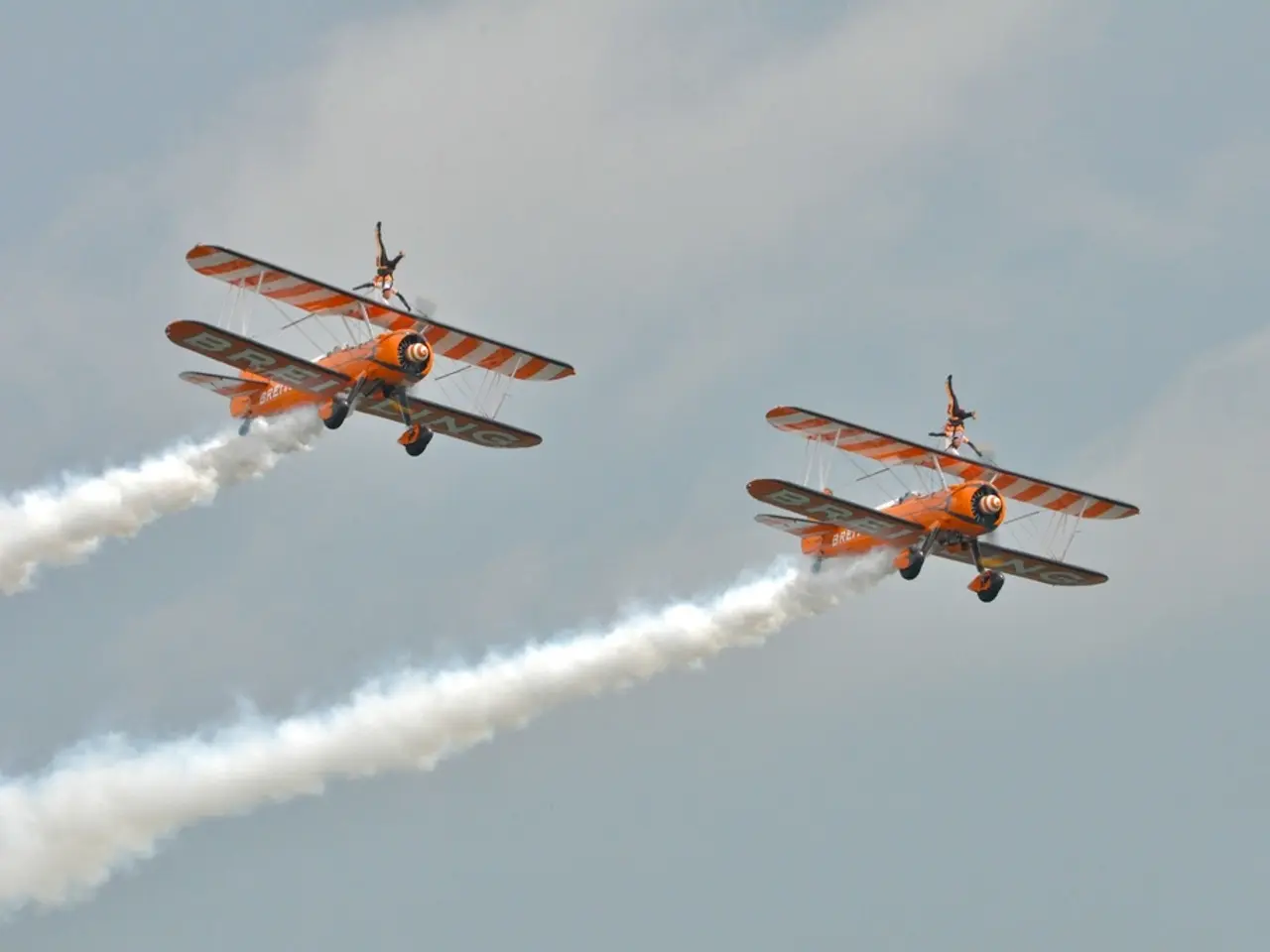
Condensation Strips Harming the Environment: An Analysis
In the ongoing fight against climate change, a lesser-known culprit has come to the forefront - contrails, the ice-crystal clouds formed by aircraft engine exhaust mixing with cold, moist air at high altitudes. Recent studies suggest that contrails and their associated non-CO2 effects could account for more than 60% of aviation's total climate damage, potentially equaling or exceeding the warming effect of aviation's direct CO2 emissions.
### The Impact of Contrails and Associated Factors
Contrails have a net warming effect by trapping Earth's outgoing heat, particularly impactful at night. During the day, they can reflect some sunlight, which has a partial cooling effect. CO2 emissions, on the other hand, are direct greenhouse gas emissions, well quantified but less significant than combined non-CO2 effects like contrails.
Aviation also produces nitrogen oxides (NOx), which affect ozone and methane chemistry at high altitudes, indirectly influencing warming. Particles emitted, such as aerosols and soot, act as nuclei for ice crystals in contrails or influence cloud properties, contributing to cloud formation and warming.
### The Challenges of Contrails
The formation of contrails depends critically on atmospheric conditions, making their occurrence and climate effect highly variable and complex to model. Contrails can trap heat at night, leading to net warming, although during the day they can reflect some sunlight, which has a partial cooling effect. They may also contribute to an increase in cirrus cloud cover, which on average also warms the climate by trapping infrared radiation.
### Strategies for Reducing Contrails' Environmental Effects
1. Flight Path Optimization (Contrail Avoidance): Rerouting aircraft to avoid atmospheric conditions conducive to contrail formation has been shown to potentially reduce contrail formation by 3-5%.
2. Timing Flights: Avoiding flights during night or times of day when contrails trap heat more effectively could reduce warming impacts without major operational changes.
3. Improved Atmospheric Monitoring and Predictive Modeling: Advances in understanding atmospheric conditions that lead to contrails enable smarter flight decisions to mitigate their formation proactively.
4. Technological and Engine Improvements: Reducing soot and particulate emissions from engines lowers ice nucleation sites for contrails, potentially diminishing their persistence and impact.
### The Way Forward
As the EU mandates European airlines to determine and report the non-CO2 effects of their European flights, research projects like the German Aerospace Center's "D-Kult" aim to redirect more than 100 regular flights of German airlines in 2024 to avoid contrails. However, secure statements about actually avoided climate effects are currently not possible.
The scientists from Future Cleantech Architects recommend the targeted use of sustainably produced synthetic fuels (SAF) on flights where particularly many contrails are expected. The integration of non-CO2 effects into the existing CO2 emissions trading system, as proposed by the EU, could further burden European airlines in competition with providers from Turkey or the Arab region.
In conclusion, tackling contrails and associated non-CO2 effects is a significant step towards reducing aviation's climate impact. Emerging strategies, particularly smart rerouting of flights to avoid contrail-prone conditions, offer promising, relatively straightforward ways to significantly cut this warming effect without severely compromising fuel efficiency or operational feasibility. This balanced approach could lead to meaningful climate benefits in the near term while broader technological advancements continue to evolve.
- The net warming effect of contrails, formed by aircraft engine exhaust, is significant as they trap Earth's outgoing heat, contributing more to climate change than direct CO2 emissions from aviation industry.
- Aviation also releases nitrogen oxides (NOx) and particles like aerosols and soot, which impact high-altitude ozone and methane chemistry, as well as contribute to ice crystal formation in contrails or cloud properties.
- Strategies to reduce contrails' environmental effects include flight path optimization, timing flights appropriately, improvements in atmospheric monitoring and predictive modeling, and technological and engine advancements that minimize particulate emissions.
- The usage of sustainably produced synthetic fuels on flights with high contrail potential and the integration of non-CO2 effects into the existing CO2 emissions trading system could further help minimize aviation's climate impact.