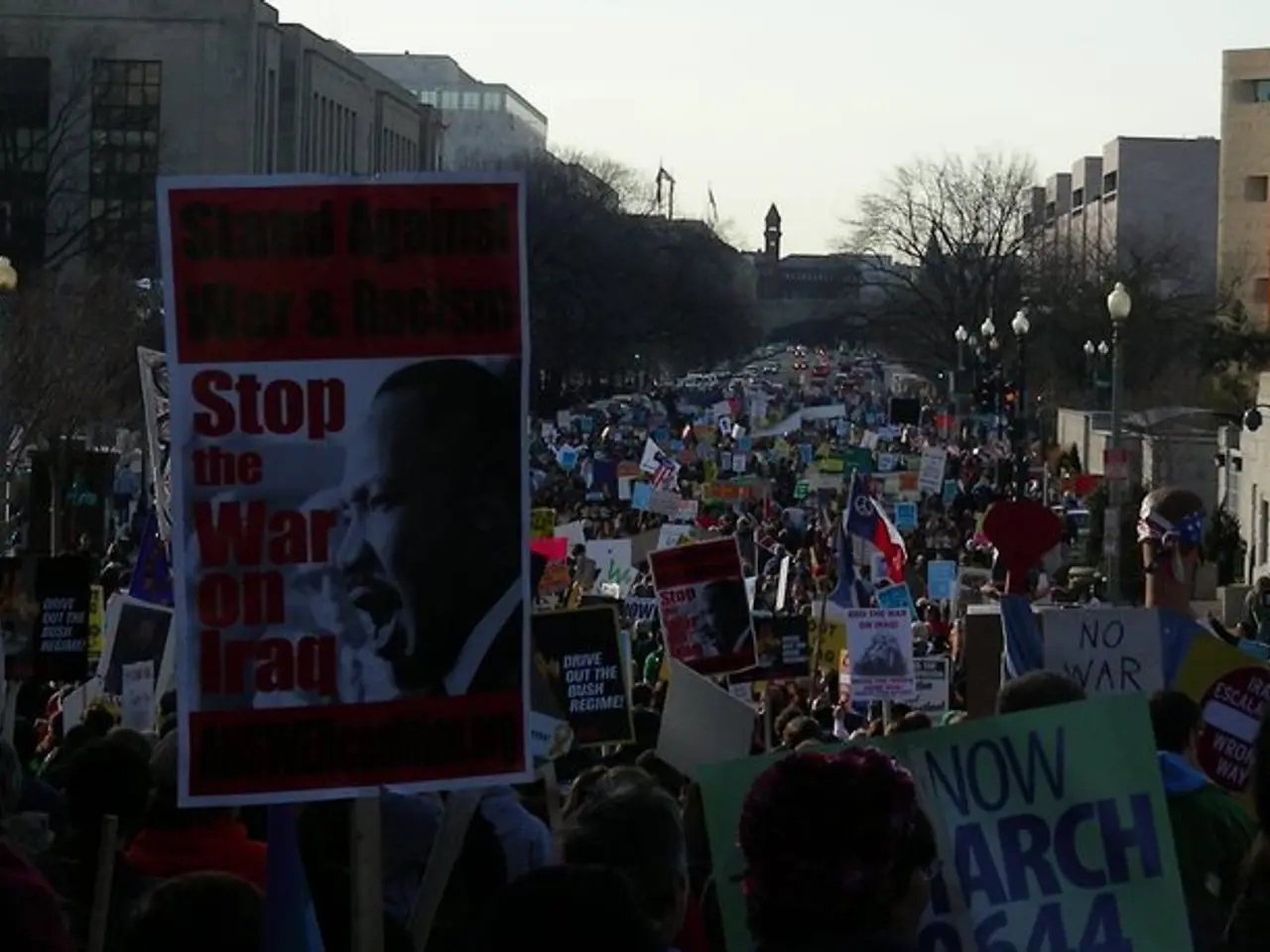
Germany’s peace movement struggles to regain its 1980s momentum against war
The German peace movement is calling for dialogue with Russia, but critics argue it lacks concrete plans and support from key players. Recent rallies drew tens of thousands, yet fall short of past protests.
Jürgen Grässlin, spokesperson for the German Peace Society–United War Resisters (DFG-VK), criticized world leaders and the German chancellor at a rally. However, he offered little beyond urging politicians to stop arming and start talking to Russia. The peace movement's appeal demands diplomacy and détente, but it does not address the root causes of conflicts or propose concrete political changes.
The movement's potential is vast. Large German arms manufacturers like Rheinmetall, Krauss-Maffei Wegmann, Hensoldt, and Diehl Defence could halt Germany's war machine if their workers stopped production. Unions and left-wing NGOs, such as the Berlin Alliance against Weapons Production and 'Rheinmetall Entwaffnen', could play a crucial role in organizing resistance. Despite this, the movement has not reached the scale of the 1980s protests against NATO's missile deployment. Recent rallies in Berlin and Stuttgart drew 20,000 and 15,000 activists respectively, compared to hundreds of thousands in the past.
The peace movement's appeal for dialogue and disarmament is gaining traction, with several hundred organizations endorsing the 'Never Again War!' call to action. However, it must address the root causes of conflicts and engage key players, such as trade unions, to effectively resist the 'Zeitenwende' and achieve its goals.
Read also:
- American teenagers taking up farming roles previously filled by immigrants, a concept revisited from 1965's labor market shift.
- Weekly affairs in the German Federal Parliament (Bundestag)
- Landslide claims seven lives, injures six individuals while they work to restore a water channel in the northern region of Pakistan
- Escalating conflict in Sudan has prompted the United Nations to announce a critical gender crisis, highlighting the disproportionate impact of the ongoing violence on women and girls.