Largest German shipyard TKMS achieves self-sufficiency
In a significant corporate restructuring, Germany's largest naval shipbuilder, ThyssenKrupp Marine Systems (TKMS), is set to become an independent, publicly listed company. The spin-off aims to promote TKMS's independent growth, innovation, and market responsiveness while offering minority shareholders direct involvement in the new entity.
The potential members of TKMS's supervisory board have not been explicitly named. However, the current chairman of the supervisory board of thyssenkrupp AG, Prof. Dr.-Ing. Siegfried Russwurm, remains a key figure connected to the spin-off and its governance. Thyssenkrupp AG will retain a 51% stake in TKMS, ensuring strategic stability.
Minority shareholders, holding 49% of TKMS directly, will gain proportional stakes and benefit from direct trading and access to capital markets independent of the majority shareholder. This approach is designed to promote TKMS's innovative strength and flexibility while maintaining the strategic guidance of thyssenkrupp as the majority owner.
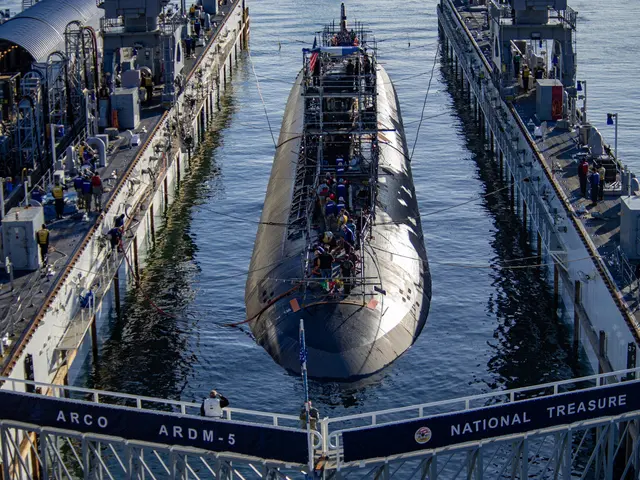
TKMS is the world leader in non-nuclear operated submarines and also builds frigates and corvettes. The company employs around 8,300 people across shipyard locations in Kiel, Wismar, Itajaí (Brazil), and other sites such as Hamburg, Bremen, and Emden.
Recently, TKMS was awarded the construction of the new German research ship 'Polarstern 2' with an order volume of around 1.2 billion euros. Singapore has also ordered two more submarines from TKMS for the Indo-Pacific region. The order backlog of TKMS has grown by more than 50% since the end of September, reaching over 18 billion euros.
The spin-off of TKMS from Thyssenkrupp is expected to be completed in mid-October, followed by an IPO. Oliver Burkhard, who was previously the HR director at Thyssenkrupp, is the CEO of TKMS.
The security agreement between TKMS and the federal government includes special information and consultation rights for sensitive activities. Thyssenkrupp is open to further dialogue about a potential federal government stake. The security agreement is expected to be completed by the end of September.
Critics, such as Hendrik Schmidt of the fund company DWS, have called for a predominantly independent supervisory body to safeguard the interests of minority shareholders. Marc Tüngler of the German Shareholder Protection Association (DSW) believes that a clear focus on the respective business can lead to better corporate management and decisions.
Despite these concerns, the TKMS supervisory board chairman, Volkmar Dinstuhl, has stated that shareholders expressed themselves predominantly positively about the spin-off. The largest single shareholder of Thyssenkrupp AG, the Krupp Foundation with a stake of 21 percent, is to receive a seat on the TKMS supervisory board.
Thyssenkrupp remains open to discussions about a potential federal government stake in TKMS, but it is not part of the current agreement. The spin-off of TKMS is part of a larger restructuring at Thyssenkrupp, with the other four divisions also to be set up independently and opened up for third-party participation.
The spin-off of TKMS, an independent company focusing on non-nuclear operated submarines, frigates, and corvettes, is anticipated to strengthen its business in the aerospace, finance, and broader industrial sectors, utilising capital markets for growth and innovation. Shareholders, including the Krupp Foundation, are poised to benefit from direct trading and access to capital markets, aiming to ensure TKMS's market responsiveness and strategic guidance from Thyssenkrupp.