Uncovering the underpinnings: Insights revealed
**Eurofighters Create Sonic Booms During Training Flights**
Residents in southern Germany were treated to an unexpected sonic show this week as Eurofighter jets from Neuburg flew over the region, creating a series of loud booms.
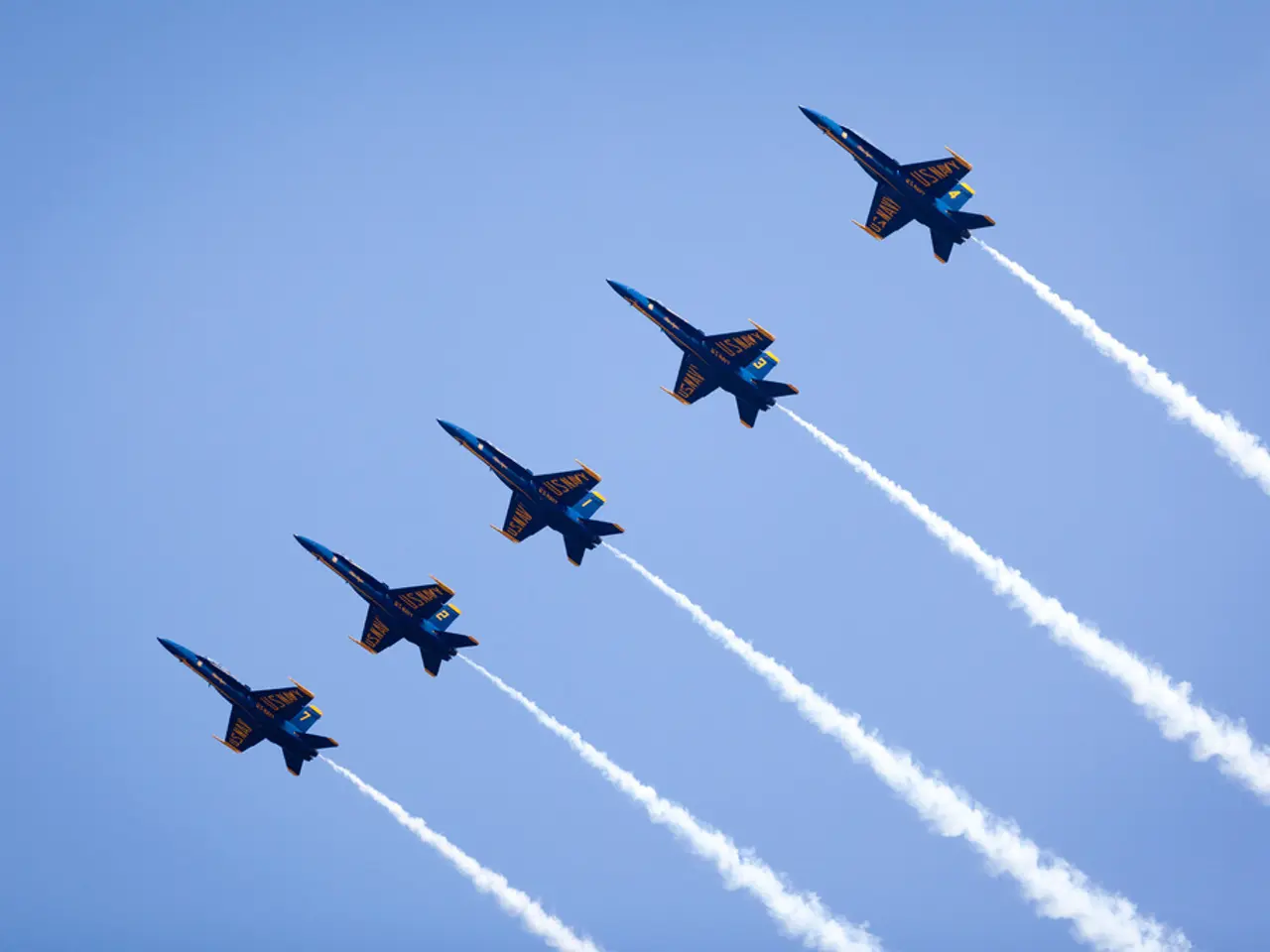
The sonic booms are a result of the aircraft breaking the sound barrier during supersonic flight. When an aircraft exceeds the speed of sound, it compresses air molecules ahead of it, leading to a sudden change in air pressure. This rapid pressure change propagates as shock waves, which reach the ground as a loud, explosive noise.
The Eurofighter Typhoon, a supersonic fighter jet, is no exception to this rule. During their high-speed training maneuvers, these jets produce sonic booms as they break the sound barrier. The sonic boom is essentially a byproduct of supersonic flight and is perceived as a loud "boom" or thunder-like sound.
On Monday, the Neuburg Eurofighters were engaged in training flights, flying between Ulm, Munich, and Stuttgart. The loud bangs that were heard in the afternoon were a direct result of these flights. However, it's important to note that the pilots do not hear the loud bang as they are flying faster than the speed of sound and are thus insulated from the sound waves.
The Neuburg Eurofighters have a crucial role in monitoring southern German airspace. In case of an emergency, they can be in the air within a few minutes, ready to respond swiftly and effectively.
This phenomenon is not unique to Eurofighters but is common to all supersonic military aircraft. The loud noises that accompanied the Eurofighters' training flights this week serve as a reminder of the incredible technology and speed these jets possess.
[1] Supersonic booms occur when an aircraft exceeds Mach 1, producing shock waves. [2] These shock waves reach the ground as loud booms during training flights. [3] Eurofighters produce such sounds during supersonic flight phases in their training. [4] The Neuburg Eurofighters are responsible for monitoring southern German airspace. [5] In case of an emergency, the Neuburg Eurofighters can be in the air within a few minutes. [6] The Eurofighters went into supersonic flight, which is approximately 1,200 km/h.
The aerospace industry's supersonic military aircraft, such as the Eurofighter, produce loud, thunder-like sounds known as sonic booms when they exceed Mach 1 during training flights. These sonic booms are a result of shock waves created by the aircraft's supersonic flight, with the Neuburg Eurofighters specifically being responsible for monitoring southern German airspace and ready to respond in emergencies.