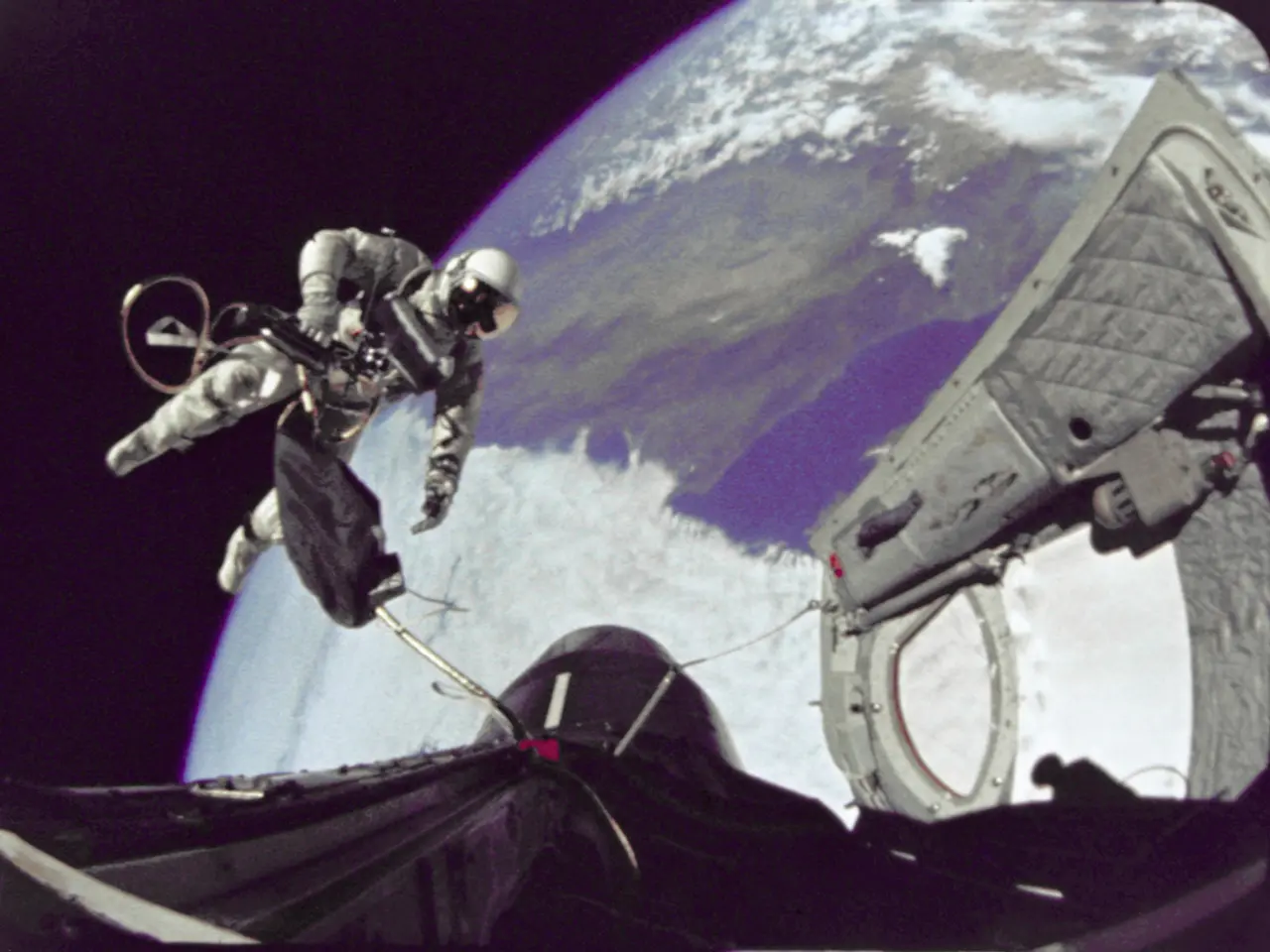
US Astronaut John Herschel Glenn was the pioneer who first orbited Earth
John Glenn, America's First Astronaut, Soars Again at 77
John Herschel Glenn, the first American astronaut to orbit the Earth, made history once more in 1998 when he embarked on a second space flight at the age of 77. This remarkable journey on the space shuttle Discovery not only broke the record for the oldest person in space but also cemented Glenn's legacy as a pioneer in space exploration.
Born in 1921, Glenn was 40 years old during his historic 1962 flight aboard the Friendship 7 capsule. Prior to this, he had already distinguished himself as a test pilot, breaking the intercontinental speed record. His second space flight, which occurred 35 years after his first orbit, was no less significant.
Glenn was the last survivor of the original Mercury 7 astronauts at the time of his second space flight. During his first flight, the calculations for his launch were rechecked by Katherine Johnson, a NASA mathematician whose precise calculations of orbital mechanics were critical to the success of NASA's early space missions. Johnson's work, which broke racial and gender barriers, helped shape America’s space exploration efforts.
Glenn's second space flight was not without experiments. He conducted numerous studies during the mission, contributing to the advancement of space research. However, Glenn, who had also taken part in two separate battles as a fighter pilot, did not let fear hinder his achievements. When asked about his experiences during his flights, he simply answered that he did not experience fear that prevented him from doing what was expected.
Before his space adventures, Glenn had a personal life that was as remarkable as his professional one. In 1943, he married his childhood sweetheart, Anna Margaret Castor. Their friendship dated back to when they were children, and Glenn helped her during her illness by giving her a radio.
Glenn's contributions to space exploration did not end with his second space flight. After his aviation and space career, he served as a senator from Ohio for 24 years. In 1995, he retired from the US Senate, becoming the longest serving senator in the State's history. Glenn passed away in 2016 at the age of 95, leaving behind a legacy that continues to inspire.
References:
- National Aeronautics and Space Administration (NASA). (2016). John H. Glenn Jr. Biography. [online] Available at: https://www.nasa.gov/mission_pages/biographies/glenn-john-h.html
- Johnson, K. (2016). Reaching for the Stars: The Making of NASA's First Women Astronauts. HarperCollins Publishers.
- Smithsonian National Air and Space Museum. (2016). John H. Glenn Jr. [online] Available at: https://airandspace.si.edu/exhibitions/john-glenn/
- National Women's History Museum. (2016). Katherine Johnson. [online] Available at: https://www.womenshistory.org/education-resources/biographies/katherine-johnson
Aviation pioneers such as John Glenn contributed significantly to the transportation industry, with Glenn breaking the intercontinental speed record as a test pilot before becoming America's first astronaut. Glenn's achievements in space-and-astronomy, including his famous 1962 flight and his record-breaking second mission in 1998 at the age of 77, highlighted the intersection of science, industry, and finance in advancing human exploration of space. As a senator for 24 years, Glenn continued to shape policy in the realm of science and technology, leaving behind a lasting legacy that extends beyond aviation.