Demolition of Ernst Thälmann Memorial Sparks Decades-Long Historical Dispute
The tavern has long since vanished. But around the historic meeting hall, the GDR constructed the Ernst Thälmann Memorial in Ziegenhals, inaugurated in 1953. Despite its listed heritage status, it was demolished in 2010. Gerd Gröger, then a senior official in Brandenburg's Ministry of Infrastructure, acquired the prime waterfront property for just €86,000 from the Treuhand-owned TLG. The bargain price came with a condition: preserving the memorial. Yet a legal amendment that took effect on August 1, 2004—conveniently for Gröger, an expert in heritage protection—allowed him to raze the Thälmann Memorial, dramatically increasing the land's value. After some back-and-forth, he had the site destroyed in 2010, replacing it with twin houses and condominiums.
Still, the Friends of the Ernst Thälmann Memorial continues to gather three times a year outside the grounds, holding rallies to honor Thälmann and the Ziegenhals conference—always on the anniversary of the historic February meeting, on Thälmann's birthday in April, and to mark the anniversary of his murder in August 1944 at Buchenwald concentration camp. Thälmann was one of the most prominent political prisoners of the fascist regime, which is why it seems fitting that the Association of Victims of the Nazi Regime (VVN) displays its flag at these events—as it did at the most recent rally on February 8.
"We call on the state government to put an end to this deliberate or unintentional confusion of symbols and to provide better training for its police forces."
—Max Renkl, Head of the Friends of the Thälmann Memorial
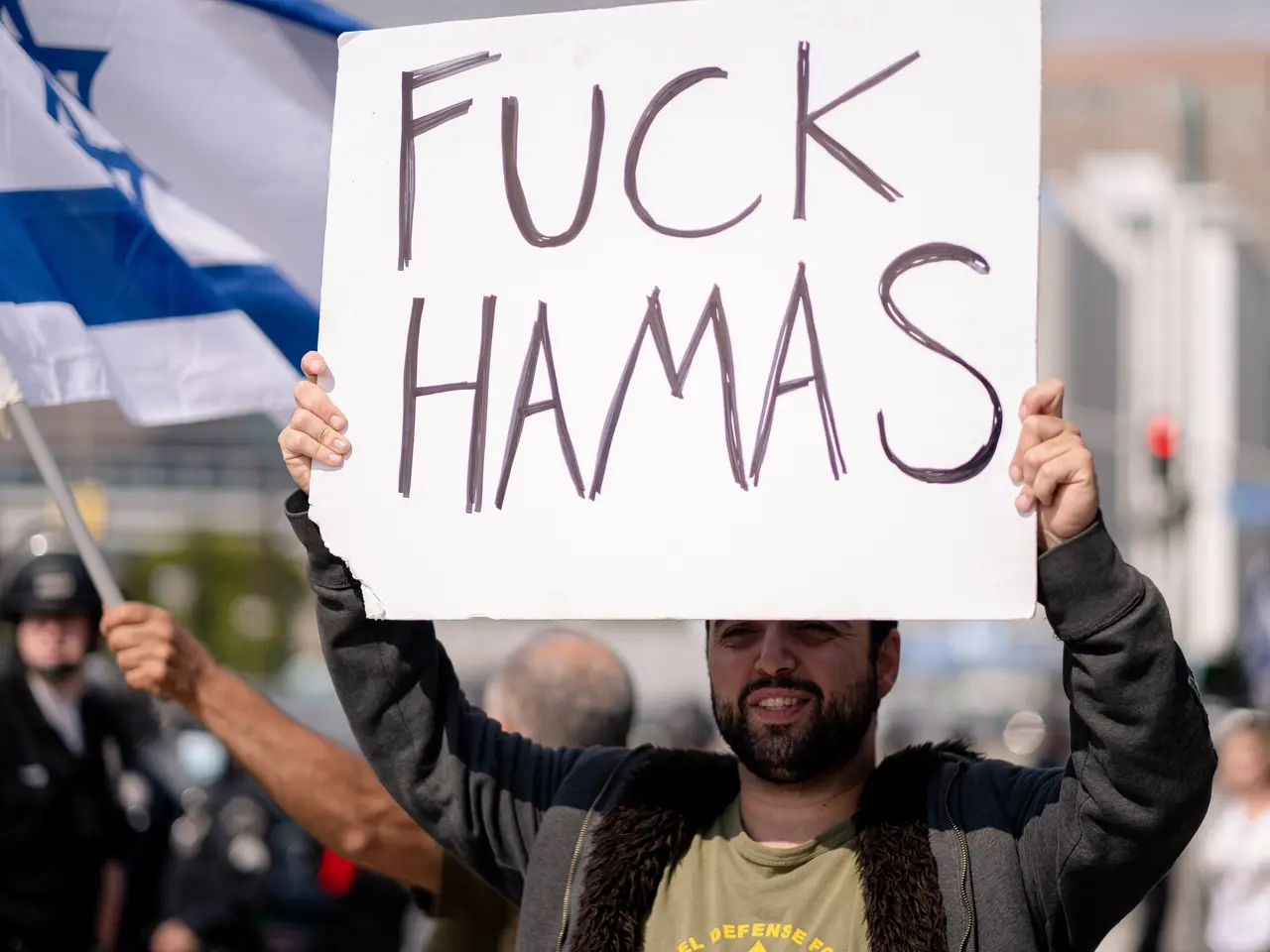
Andreas Eichner, who attended the event, estimates that 60 to 80 people were present. One man arrived with a large VVN flag, which has featured a red triangle on a blue-and-white striped background since 1947—a design rooted in history. The SS used a red triangle on the standard blue-and-white camp uniforms to mark political prisoners in concentration camps. Yet in recent times, uninformed police officers have repeatedly misinterpreted the red triangle as the red emblem used by the Palestinian group Hamas to mark its enemies. That's exactly what happened in Ziegenhals. Eichner reports that officers photographed the flag and recorded the bearer's details. After consulting a superior and a duty prosecutor by phone, the man was told that the flag would only be considered non-prohibited in the context of this specific commemoration—and would not be confiscated.
State lawmaker Sven Hornauf (BSW) has put questions to Brandenburg's Interior Minister René Wilke (SPD), demanding answers. Among other things, Hornauf wants to know how the state government plans to exercise its authority over the police and public prosecutors to stop the "harassment and criminalization" of those displaying the VVN-BdA symbol. He also asks whether a flag like the one shown in Ziegenhals would be deemed illegal if used on any occasion other than a memorial for the victims of fascism.
Hornauf has yet to receive a response. During the Interior Committee meeting on February 11, BSW parliamentary group leader Niels-Olaf Lüders pressed further, asking whether people should now fear carrying a VVN flag—or even walking around with a bottle of Apollinaris mineral water, which also features a red triangle. Even though the individual in Ziegenhals was ultimately allowed to leave, Lüders argued that such incidents intimidate people when they find themselves subjected to police scrutiny for using a symbol that had previously gone unchallenged.
Interior Minister Wilke deflected, saying, "I can't comment much on the incident itself." After all, Hornauf's inquiry was still being processed. The ministry needed time to examine the case, he explained, asking for patience.
Max Renkl, chair of the Friends of the Ernst Thälmann Memorial, has condemned as a scandal the way police in Ziegenhals treated a flag-bearer as if he were carrying a Hamas symbol. Renkl stressed that the Association of Victims of the Nazi Regime (VVN-BdA) is Germany's oldest anti-fascist organization. "We call on the state government to put an end to this deliberate or unintentional conflation of symbols and to provide better training for its police forces," he said, "so that we and other anti-fascists no longer face such disruptions at our events." He pointed out that monuments to the victims of fascism also bear the same red triangle. "A little education wouldn't hurt," Renkl remarked.
Markus Tervooren, managing director of the VVN-BdA in Berlin, sees this as a clear gap in knowledge. He has repeatedly encountered police officers who initially suspect his organization's flags of being Hamas symbols, only to back down after consulting their superiors by phone. But according to Tervooren, ignorance extends beyond law enforcement—it is widespread in the general public, especially among young people. Over the weekend, he was in Dresden, where neo-Nazis marched to mark the anniversary of the city's bombing in World War II. Tervooren joined the counter-protest with a VVN flag and was approached by many young people. "I experienced the full spectrum of misunderstandings," he reported. Some berated him for allegedly displaying an Islamist Hamas symbol, while others praised him for supposedly protesting Israeli colonialism. Most, however, had no idea what the flag represented, giving Tervooren an opportunity to educate them.
Brandenburg's anti-Semitism commissioner, Andreas Büttner, has already taken a clear stance. In December, he stated that the historic VVN triangle is not a Hamas symbol but represents victims of the Nazi regime and anti-fascist resistance. "We must focus our resources on real anti-Semitic threats—not on historical markers of persecution that have stood for decades as symbols of remembrance and warning," said Büttner, who served as a Left Party member of the state parliament until 2024.
Read also:
- American teenagers taking up farming roles previously filled by immigrants, a concept revisited from 1965's labor market shift.
- Weekly affairs in the German Federal Parliament (Bundestag)
- Landslide claims seven lives, injures six individuals while they work to restore a water channel in the northern region of Pakistan
- Escalating conflict in Sudan has prompted the United Nations to announce a critical gender crisis, highlighting the disproportionate impact of the ongoing violence on women and girls.