Berlin honors Armenian Genocide victims with art, memorials, and reflection
Ani Petrosyan's voice cracks as she begins to speak. She swallows hard, fighting back tears for a moment before composing herself. What she is about to share is still raw, even for her. "It was only last year that I learned more about how my family tried to flee to safety over a hundred years ago," she says. Her grandparents had been forced to escape the Armenian Genocide in the Ottoman Empire. At the time, the Young Turks persecuted Christian minorities—driving them from their villages, sending them on death marches, and slaughtering them. An estimated 1.5 million people were killed, including not only Armenians but also Pontic Greeks and Assyrians.
"My ancestors fled 400 kilometers on foot to reach the border river, and they crossed it, even though it was deadly," Petrosyan says. Several of her relatives drowned in its waters. She describes how her family settled in the first village across the border in Armenia—a place that became multicultural as other survivors sought refuge there.
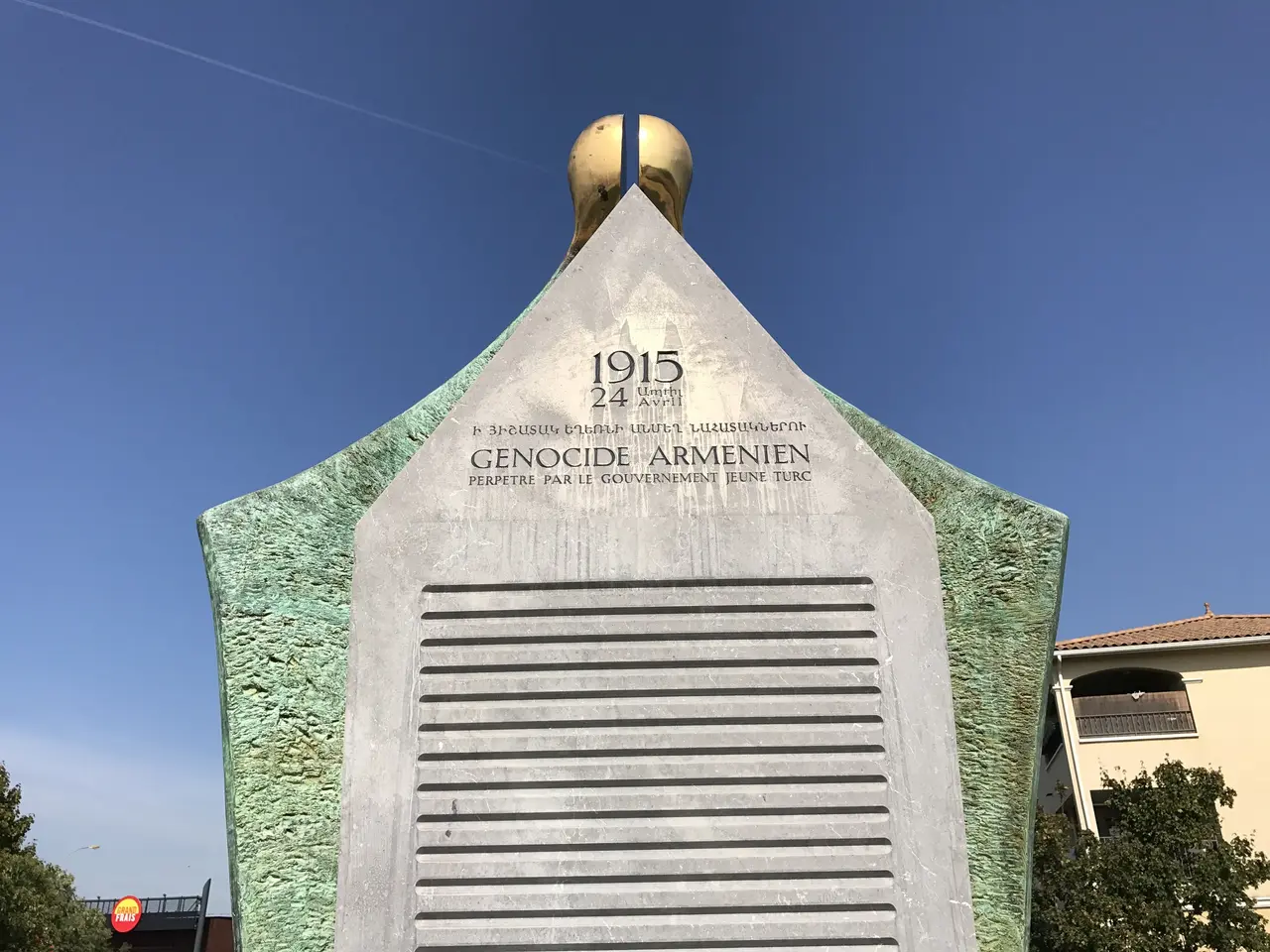
Petrosyan shares her story on April 24, the official day of remembrance for the Armenian Genocide. As co-chair of the Armenian Youth of Berlin-Brandenburg (AJBB), her organization lays a wreath on Friday evening at the Armenian khachkar (cross-stone) near St. Hedwig's Church in Mitte. Alongside burning candles, a large wreath from the Armenian Embassy and countless individual flowers are already in place. Around 50 people have gathered for the AJBB's memorial ceremony. "We are deeply moved that so many have come," says Diana Piruzyan, also a chair of the AJBB. They had not expected such a strong show of solidarity—when registering the event with authorities, they had only accounted for 15 to 20 attendees.
The number of events commemorating the genocide in Berlin this year is equally striking. On Thursday evening, the initiative "Time to Talk" hosted a discussion at Spore in Neukölln on the genocide and its relevance today, while the association Akebi, in collaboration with the Charlottenburg Museum, screened short films related to the genocide and its remembrance, along with a presentation on Armenian intellectual and journalist Hrant Dink.
The Gorki Theatre has commemorated the genocide for years
Hrant Dink was assassinated in 2007 on an Istanbul street outside his newspaper's offices, in part because of his advocacy for genocide recognition. The Gorki Theatre, which has consistently marked the genocide and Dink's death in January with exhibitions and lectures for years, staged the play "Donation" on Friday evening—a production exploring the genocide and the 2023 expulsion of Armenians from Artsakh. Meanwhile, the Recognition Working Group (A.G.A.) announced a memorial event for Sunday evening at the ecumenical memorial site on the Luisenkirchhof, a Protestant cemetery in Charlottenburg.
On Saturday evening, Akebi and the House of World Cultures hosted an exhibition of contemporary Armenian art. Akebi is a collective of people with Armenian, Turkish, and Kurdish backgrounds who advocate for a vibrant, post-migrant culture of remembrance in Berlin. The event included a discussion with journalist Tigran Petrosyan, historian Elke Shogig Hartmann, and art historian Banu Karaca on Germany's complicity in the genocide and its implications for memory culture today.
Germany has recognized the genocide—but it remains far from a standard part of the country's collective memory.
The German Empire, as a wartime ally of the Ottoman Empire, was deeply involved in the crimes, even providing refuge in Berlin for responsible officials. In a 2016 resolution, the Bundestag formally recognized the deportation and massacre of Christians in the Ottoman Empire as genocide and acknowledged Germany's share of responsibility. The resolution also calls on the country to actively engage in remembrance and education.
"Germany has acknowledged the genocide and its own complicity," says Asuman Kırlangıç of Akebi. "But to this day, the genocide is not an integral part of German culture of remembrance. Acknowledgment also means protecting Armenian lives"—as a minority, Armenians still face widespread threats today, she adds.
A Garden for Feminist Mari Beylerian
A visible memorial will remain at Berlin's House of World Cultures. Since Saturday, part of the garden along the Spree has been named after Mari Beylerian, an Armenian feminist likely among the roughly 200 intellectuals whose arrest in Constantinople on April 24, 1915, marked a clear beginning of the genocide. As early as 1895, she had spoken out against the persecution of Armenians in the Ottoman Empire and advocated for women's rights. She was probably murdered in custody, explains Lusin Reinsch of Akebi at the garden's dedication.
"Recognition of a genocide rings hollow if not accompanied by concrete acts of remembrance, commemoration, and taking responsibility," Reinsch emphasizes. She also notes: "Ten years ago, no one in the Armenian community could have imagined we would have as many events this year as we do now."
This progress is also thanks to strong partners who have engaged with the issue long-term—such as the Spore Initiative, the House of World Cultures (which has provided a space for commemoration for the second consecutive year), the Gorki Theatre, and, since last year, the Charlottenburg-Wilmersdorf Museum, which will continue its collaboration with Akebi. Reinsch stresses that institutional support like this is crucial to ensuring that remembrance ultimately becomes a matter for society as a whole.
Read also:
- American teenagers taking up farming roles previously filled by immigrants, a concept revisited from 1965's labor market shift.
- Weekly affairs in the German Federal Parliament (Bundestag)
- Landslide claims seven lives, injures six individuals while they work to restore a water channel in the northern region of Pakistan
- Escalating conflict in Sudan has prompted the United Nations to announce a critical gender crisis, highlighting the disproportionate impact of the ongoing violence on women and girls.