Braunschweig braces for May Day clash between unions and far-right rallies
Braunschweig's Anti-Far-Right Alliance Faces Back-to-Back Challenges
The anti-far-right coalition in Braunschweig has had its hands full lately. Just two weeks ago, members of the Reichsbürger movement chose the city as the site of their so-called "grand conference of federal states," demanding a return to the 1871 imperial constitution of the German Empire. "They were more like a carnival club," says Malte Stahlhut of the IG Metall union, who witnessed the event.
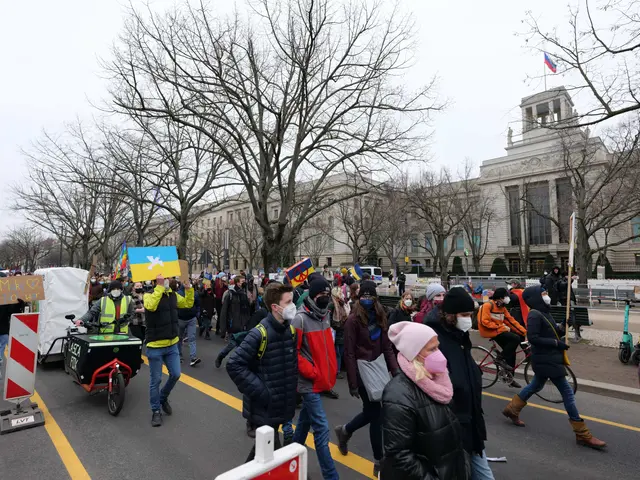
Participants had dressed up as envoys from their self-proclaimed imaginary principalities. Though organizers had registered 1,500 attendees, only around 300 Reichsbürger actually showed up—while the anti-far-right alliance mobilized some 600 counter-protesters.
Now, another far-right demonstration is on the horizon—this time, likely less picturesque. The NPD (National Democratic Party of Germany) plans to celebrate May Day in Braunschweig, immediately following the trade unions' traditional march. The NPD? While most of the neo-Nazi party rebranded as Die Heimat in 2023, a few state branches split off and continue operating under the old name. The NPD's Hamburg chapter has been promoting the event for weeks on social media with the slogan: "Day of German Labor. May 1—since 1933, a work-free holiday."
Though the far-right scene has recently tried to gain a foothold in Braunschweig, the city is not typically a right-wing stronghold. In the 2021 local elections, the far-right AfD (Alternative for Germany) secured just 4% of the vote (and two seats), while other classic far-right parties failed to win any representation. In last year's federal election, the AfD won 13.3%—still 4.5 percentage points below the state average in Lower Saxony and 7.5 points below the national average.
Far-Right March to Pass by Family Festival
Yet Braunschweig's history continues to draw the far right. The Free State of Brunswick was one of the first regions in the Weimar Republic to include the Nazi Party in its government. In 1932, it also granted Adolf Hitler German citizenship—a prerequisite for his appointment as chancellor. The far-right party Die Rechte had already chosen this symbolically charged city for a rally at the end of 2024.
Now, the NPD is following suit. On Monday, the Green Party's city council faction sent an open letter to the mayor, urging him to reject the planned route for the neo-Nazi march. The Greens argue that the demonstration is "deliberately designed to pass key locations of the democratic May Day events."
For example, a rally appears to be planned at Europaplatz—right next to the DGB trade union's "International Family Festival" in Bürgerpark, which, according to the union, has drawn up to 8,000 people in past years, mostly families with young children. "The neo-Nazis' deliberate choice of route clearly shows their intent to disrupt and intimidate, severely undermining peaceful events and claiming public space for themselves," the Greens write.
The city, they insist, must exhaust all legal options to significantly restrict the neo-Nazi march. The faction points to precedents in Leipzig and Berlin, where authorities successfully banned assemblies that "clearly endangered public safety or order."
On May 1, 1933, the Nazi Party had still marked the holiday alongside the trade unions. The very next day, stormtroopers occupied union offices and forcibly dissolved independent labor organizations.
City officials cite the right to freedom of assembly, noting that organizers are free to choose their route. Braunschweig police, meanwhile, say their security plan will ensure all events remain separate and safe.
As of Wednesday, the exact route has not been confirmed by authorities. However, according to information from the Greens, the NPD march will also pass the DGB's union headquarters—a building that, though only standing in its current location since the 1950s, holds symbolic weight. The NPD's slogan references the "first national Labor Day," which the Nazi Party declared in 1933 and initially celebrated alongside the unions—before occupying their offices on May 2 and bringing them under state control.
"We see this as a clear provocation," said Malte Stahlhut of the IG Metall union. Yet the city claims its hands are tied: "Provocations are often part of public demonstrations." "In light of the constitutional right to freedom of assembly, these must regularly be tolerated."
Against this backdrop, the union is taking matters into its own hands. The DGB's original protest was scheduled to end by 1 p.m., but organizers have now extended the program. Starting at noon, a rally will be held in front of the union headquarters, running parallel to the main demonstration. The march itself will also continue beyond its planned route: from 12:50 p.m., it will proceed from Konrad-Adenauer-Platz near Bürgerpark all the way to the union building. "We will outnumber them. We are many," Stahlhut declared confidently. After all, the people of Braunschweig have had plenty of practice lately.
Read also:
- American teenagers taking up farming roles previously filled by immigrants, a concept revisited from 1965's labor market shift.
- Weekly affairs in the German Federal Parliament (Bundestag)
- Landslide claims seven lives, injures six individuals while they work to restore a water channel in the northern region of Pakistan
- Escalating conflict in Sudan has prompted the United Nations to announce a critical gender crisis, highlighting the disproportionate impact of the ongoing violence on women and girls.